


Cashi Review: Is the Stablecoin Visa Card and Its 3-2-1% Cashback Worth It?
Cashi reviewed: who runs it, where your stablecoins sit, the virtual Visa card and its fees, how the 3%, 2% and 1% cashback caps work, what the invite gives you, who can sign up and who should skip it.
Last updated 24 October 2026

Best for
People outside the United States who already hold USDT or USDC, pay for subscriptions and shop online in US dollars, and want a virtual Visa card that spends those stablecoins with modest cashback on top.
Cashi is a tidy way to spend dollar stablecoins: a virtual Visa debit card with no monthly fee, a $5 activation fee that comes straight back as $5 of Spending Credit, and automatic cashback of 3% on a short list of monthly subscriptions, 2% on online shopping and 1% on travel. The caps keep it small: 2% applies to the first $500 a month at each named store plus $500 across all other eligible stores, and travel cashback stops at $20 a month. A heavy online month comes to about $34 in Spending Credit, which you can spend on the card but never withdraw. It is not a bank, its card issuer isn't named and the card is virtual only. Get it through our invite if you spend in dollars online; skip it if you live in the US, need deposit protection or mostly pay in other currencies, where a 1% conversion fee applies.
Pros
- Automatic cashback: 3% on eligible monthly subscriptions, 2% on online shopping and 1% on travel, with nothing to activate
- No monthly or inactivity fee, and the $5 activation fee returns at once as $5 Spending Credit
- Fund with USDC or USDT on low-fee networks such as Solana and Tron, with no Cashi deposit fee and no minimum
- No conversion fee when the merchant charges in US dollars
- Spending Credit never expires, and transfers between Cashi users are instant and free
- You set your own daily card limit, up to $50,000, and can freeze the card instantly in the app
Watch-outs
- Not a bank: Cashi's terms say balances are not deposits and no government protection scheme covers them
- Virtual card only, Apple Pay isn't supported yet, and in-store tap works only through Google Pay on Android
- A 1% conversion fee whenever a merchant charges in a currency other than US dollars
- Tight caps and long exclusions: no cashback on taxis, rideshare, fuel, public transport or car rentals
- Spending Credit can't be withdrawn or sent to anyone, and the card can't yet be closed, only frozen
- Not available to US residents or citizens, and the card-issuing partner isn't named anywhere
Current related offer
Cashi offer pageReferral links: BitBoni may earn a commission when you sign up.
Provider
Cashi
Join Cashi through the referral link and claim the invitee welcome promo shown in the live app, then earn automatic 3–2–1% cashback on eligible card spend (3% selected monthly subscriptions, 2% online shopping with caps, 1% travel with caps). Cashback lands as Spending Credit you can use on card payments — it never expires and cannot be withdrawn or transferred. Cashi is a stablecoin-funded Visa spending card, not a bank.
Requirement: Invitee welcome promo per live Cashi terms; 3-2-1 cashback subject to category caps
KYC countries: Open everywhere except 1 country
Medium10-15 minutes to install and set up; KYC and first spend take longerPayout Invitee welcome promo per live Cashi terms; 3-2-1 cashback after eligible purchases settle
Verified 24 October 2026
Full claim instructions are on the Cashi offer page.
What Cashi is, and who runs it
Cashi is an app for holding, sending and spending US dollar stablecoins, with a USD-denominated virtual Visa debit card attached. You top up with USDT or USDC (or BTC, ETH and SOL), and the card spends that balance anywhere Visa is accepted. There is no credit line: it is a debit card, so you can only spend what you hold.
Your contract is with Cashi Ltd., a company incorporated in Hong Kong, under Hong Kong law, with disputes settled by arbitration at the Hong Kong International Arbitration Centre. The terms, effective 14 October 2026, name one regulated affiliate: GBP Payments Corp., a Canadian money services business registered with FINTRAC. Cashi describes itself as providing "technology services only", with the card issued by an unnamed card-issuing partner on the Visa network. FINTRAC registration is an anti-money-laundering registration, not a banking licence.
Disclosure: the invite on this page is our own Cashi invite, so Cashi credits us $5 of Spending Credit once you have spent $50 with your card.
Where your money sits
Cashi's terms say the assets you deposit are your property, held by Cashi for you, possibly in pooled (omnibus) wallets with your share tracked on its own ledger and with sub-custodians it may appoint. It says it won't lend, pledge or rehypothecate them, and that they are not available to the creditors of Cashi or its licensed affiliates.
What you don't get is deposit protection. The terms state plainly that your assets "are not deposits and are not protected by any government deposit protection or compensation scheme". You also carry the stablecoin itself: USDT and USDC are designed to hold $1, but that depends on their issuers, not on Cashi. Refunds from merchants come back in USDC whichever asset paid for the purchase.
Treat Cashi as a spending wallet, not a savings account. Keep only what you plan to spend over the next few weeks on it.
The card and how you fund it
The card lives in the app; Cashi says physical cards will come later but gives no date. Online, you pay with the card number, expiry and CVV. In shops, Android users can add it to Google Pay and tap. Apple Pay is "on our roadmap", so on an iPhone the card is for online and in-app payments only for now.
Supported assets and networks: USDT on Ethereum, Arbitrum, BNB Chain, Solana and Tron; USDC on Ethereum, Arbitrum, Base, BNB Chain, Polygon and Solana; BTC on Bitcoin; ETH on Ethereum, Arbitrum and Base; and SOL on Solana. Cashi charges nothing to receive crypto and has no minimum; the sending wallet or exchange pays the network fee, which Cashi puts at fractions of a cent on Solana, Tron and Polygon and anything from a few cents to a few dollars on Ethereum. Sending to the wrong network can lose the funds for good.
In supported countries you can also deposit and withdraw local currency (Cashi says 20+ currencies), with a fee the app shows before you confirm, and some users get a personal USD account that receives ACH, Fedwire and SWIFT payments and converts each dollar 1:1 into USDT or USDC. Receiving is free; sending out of it costs a bank fee plus a small transfer fee, and it is limited to $3,000 in any 7 days until you upgrade by uploading proof of address.
Fees and limits
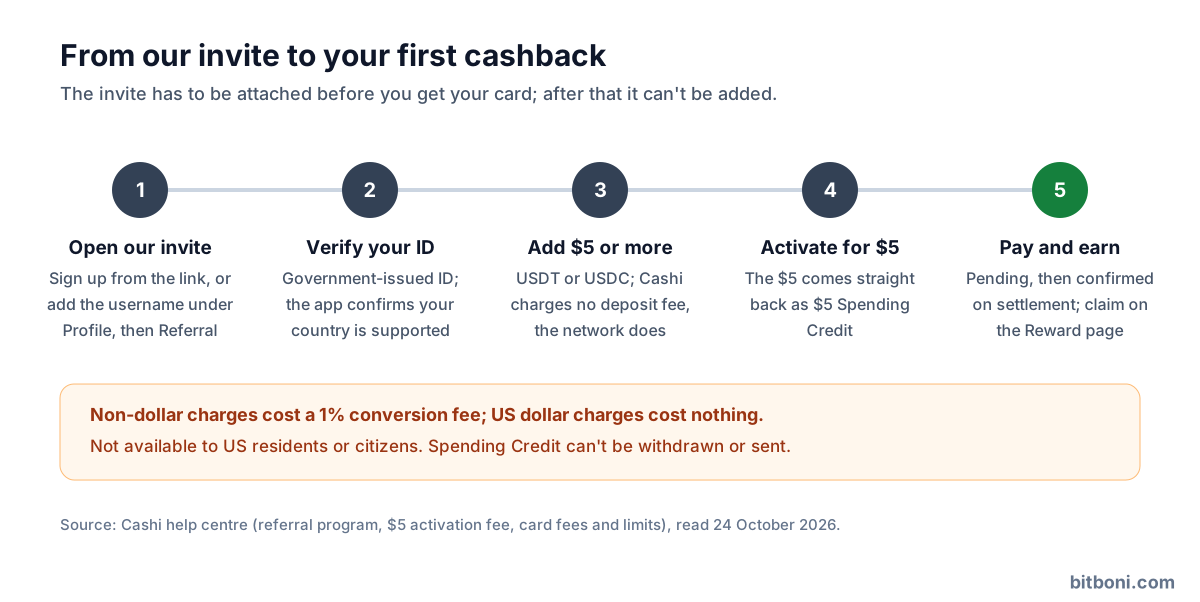
Activation: $5, taken from your cash balance when you activate the card, and returned immediately as $5 of Spending Credit, so the card costs nothing overall. You need at least $5 in your cash balance first; existing Spending Credit can't pay it. Monthly and inactivity fees: none. Minimum balance: none.
Currency conversion: 1% when a merchant charges in a currency other than US dollars, and nothing on US dollar charges. Card disputes: $50 to raise a formal dispute (asking the merchant for a refund is free). Wrong-network deposit recovery: $10, charged only if Cashi gets the funds back.
Limits: you set your own daily spending limit in the app, up to $50,000. Merchants such as car-rental firms can place a hold above the purchase price, which Cashi deducts first and settles when the final amount arrives. Cashi doesn't publish an ATM option for the card.
How the 3-2-1% cashback works
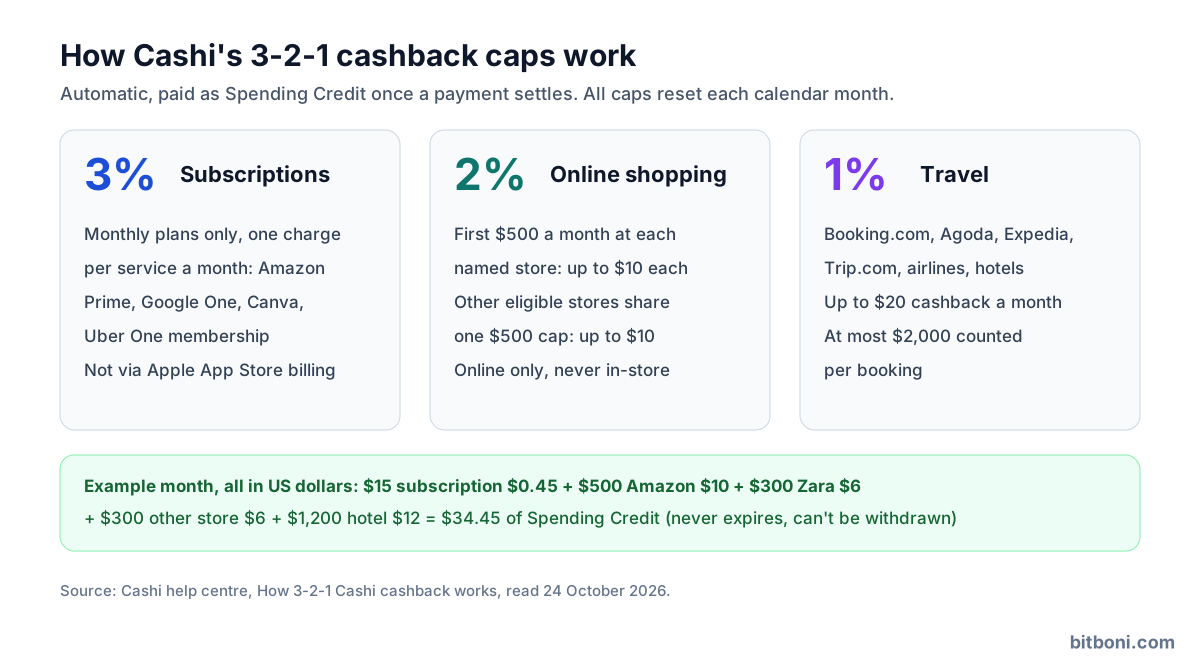
3% on subscriptions: monthly plans only, one charge per service per month, at Amazon Prime (including Prime Video on its own), Google One, Canva and the Uber One membership. Annual plans don't earn, and nor do subscriptions billed through the Apple App Store, because the charge doesn't show which service it was for; pay the service directly or through Google Play instead.
2% on online shopping: online purchases only, never in-store or tap. At the named stores (including Amazon, AliExpress, ASOS, eBay, H&M, IKEA, Nike, Shein, Temu and Zara) you earn 2% on the first $500 you spend at each store every calendar month, so up to $10 per store. All other eligible online stores share one $500 monthly cap, up to $10 in total.
1% on travel: Booking.com, Agoda, Expedia and Trip.com, plus airlines and hotels booked directly. Travel cashback is capped at $20 a month, counts at most $2,000 of any one booking, and hotel charges under $20 are excluded.
Nothing earns on cash withdrawals, transfers, trading or investments, gambling, gift cards, wallet top-ups, insurance, real estate, government payments, car rentals, cruises, taxis and rideshare, fuel, parking or public transport. Cashback shows as Pending at once and confirms when the payment settles, usually within a few days. You claim it on the Reward page as Spending Credit; refunds reverse it.
What a month is worth
Take a busy online month, all charged in US dollars: a $15 monthly subscription on the 3% list, $500 at Amazon, $300 at Zara, $300 at another eligible online store and a $1,200 hotel booked through Booking.com. That earns $0.45 + $10 + $6 + $6 + $12, or $34.45 of Spending Credit. Cashi's own help article uses the same three shopping amounts to show $22.
Push beyond the caps and the extra spending earns nothing until next month. The currency matters more: if that hotel charged in euros, the 1% conversion fee (about $12) would cancel the 1% travel cashback. The 2% online rate survives a non-dollar charge, but only half of it.
So the realistic value is tens of dollars a month for people who already shop online in dollars, paid as credit you must spend on the card. It is a pleasant extra on top of a stablecoin wallet, not a reason to move your spending.
The invite: what you get and how to keep it attached
Cashi says invited friends get a "Cashi welcome promo" but doesn't publish what it is or what it requires; the app shows it during sign-up. Separately, every new cardholder gets the $5 activation fee back as $5 of Spending Credit, invite or not.
The invite only sticks if it is added before you get your card. Open our link and sign up from it; if the app loses it, enter the inviter's username under Profile, then Referral, before you activate the card. Once you have a card the invite can no longer be added, and once a referrer is confirmed it can't be changed.
Our side is unlocked by your first $50 of settled card purchases, which can be anything: groceries, a bill, a flight or a subscription. There's no deadline. Cash withdrawals, sending money, Cashi fees, declined payments and refunded purchases don't count.
Who can sign up
You need to be 18 or over (or the legal age where you live, if higher), pass identity verification with a valid government-issued ID, and live in a supported country. Cashi says it serves 100+ countries and doesn't publish the list: the app tells you during sign-up whether registration and card issuance are available where you live, and cash deposits and the USD account are limited to some of those countries.
Cashi is not available to US residents or US citizens, wherever they live, or to residents of sanctioned or restricted jurisdictions. Its terms also include a reverse-solicitation clause: by signing up you confirm you came to Cashi on your own initiative.
What users complain about
On 24 October 2026 Cashi was rated 2.7 from 133 reviews on Google Play, with more than 5,000 downloads (last updated 22 October 2026), and 4.3 from just 6 ratings on the US App Store (version 1.8.0). The Google Play reviews split sharply between five stars and one star.
The recurring complaints: deposits that don't appear in the balance straight away, a failed first payment that worked on a retry, and support that could be quicker. The praise is for easy setup, a first online payment that went through without trouble and simple card management. With so few reviews the app is young; judge it on a small first deposit.
Leaving Cashi
You can't permanently close a Cashi card yet; you can freeze it at any time from the card screen, which blocks every new charge. If your card details are exposed, Cashi asks you to contact [email protected] for a new card.
To leave, spend your Spending Credit first (it can't be withdrawn or transferred), then send your stablecoins to another wallet, paying only the network fee. If Cashi suspends or terminates an account, its terms say it will help you withdraw remaining assets "where technically and legally feasible".
Who should get it, and who should skip it
Get it if you live outside the US in a supported country, already hold USDT or USDC, pay for Amazon Prime, Google One, Canva or Uber One monthly, and shop online at stores that charge in dollars. Join through our invite before you get your card, start with a small deposit, and use the card where it earns.
Skip it if you are a US person, want deposit protection or a bank account, need a physical card or Apple Pay, or mostly pay in your local currency: the 1% conversion fee cancels the travel cashback and halves the online rate. Don't move money into stablecoins just to earn a few dollars of Spending Credit.
FAQ
- What do I get for joining Cashi through an invite?
- Cashi says invited friends get a Cashi welcome promo but doesn't publish the amount or conditions; the app shows them during sign-up. Every new cardholder also gets the $5 activation fee back as $5 of Spending Credit.
- Can I add the invite after I've got my card?
- No. The invite has to be attached before you get your Cashi card, through the link or by entering the inviter's username under Profile, then Referral. Once confirmed, the referrer can't be changed.
- Does the $5 activation fee cost me anything?
- Not overall. Cashi takes $5 from your cash balance when you activate the card and adds $5 of Spending Credit straight away. The credit is for card payments only and can't be withdrawn.
- Can I use Cashi if I live in the US?
- No. Cashi is not available to US residents or US citizens. Elsewhere, the app tells you during sign-up whether registration and the card are available in your country.
- Is my money protected if Cashi fails?
- There's no deposit protection. Cashi's terms say your assets are held for you and aren't available to its creditors, but they are not deposits and no government protection or compensation scheme covers them.
- Do subscriptions billed through the Apple App Store earn 3%?
- No. Apple's charge doesn't show which service it was for, so Cashi excludes it. Pay the service directly or through Google Play, on a monthly plan, to earn 3%.
- Can I withdraw my cashback?
- No. Cashback becomes Spending Credit, which never expires but can only be spent with the Cashi card. It can't be withdrawn or sent to another wallet or Cashi user.
- Does Cashi work with Apple Pay?
- Not yet; Cashi lists Apple Pay as on its roadmap. Android users can add the card to Google Pay to tap in shops, and everyone can pay online with the card details.